
Sleep is supposed to be the easiest part of your day. You lie down, close your eyes, and drift off. But if you live in Darwin, you already know it does not work that way between October and April.
The wet season turns bedrooms into saunas. Fans spin all night. Sheets get kicked off. You wake up at 2am stuck to your mattress and wondering why you live in the tropics.
We wanted to stop guessing and start measuring. So we placed temperature and humidity loggers in 10 Darwin bedrooms across the northern suburbs during the 2025/2026 wet season. Here is what we found.
How We Set Up the Study
We selected 10 households across Nightcliff, Rapid Creek, Millner, Coconut Grove, and Stuart Park. Each home was a typical Darwin elevated house or ground-level unit. We placed a small digital logger on the bedside table in each master bedroom. The loggers recorded temperature and relative humidity every 30 minutes from November 1 through March 15.
We did not control for air conditioning use. Some homes ran split systems all night. Others relied on ceiling fans only. Two homes used a combination of both. This mix was intentional because it reflects how Darwin households actually sleep.
The Numbers That Stood Out
The average overnight bedroom temperature across all 10 homes was 28.4 degrees Celsius. That is well above the range most sleep researchers consider ideal for quality rest (between 18 and 22 degrees).
Even in homes running air conditioning, the average bedroom temperature only dropped to 25.1 degrees. The units struggled to keep up, especially during January and February when daytime humidity regularly topped 80 percent.
Homes relying on fans alone averaged 30.2 degrees overnight. The fans moved air but did not reduce the actual temperature of the room or the mattress surface.
The highest single reading we recorded was 33.8 degrees at 11:45pm in a Coconut Grove unit during a late January humidity spike. The lowest overnight reading was 23.6 degrees in a Stuart Park home running a modern inverter split system on its lowest setting.
Humidity Was the Hidden Problem
Temperature gets all the attention. But the data showed humidity was doing just as much damage to sleep quality.
The average overnight relative humidity across all 10 bedrooms was 74 percent. In the fan-only homes, humidity averaged 81 percent. Even air-conditioned bedrooms still averaged 65 percent because opening and closing doors through the evening let moisture back in.
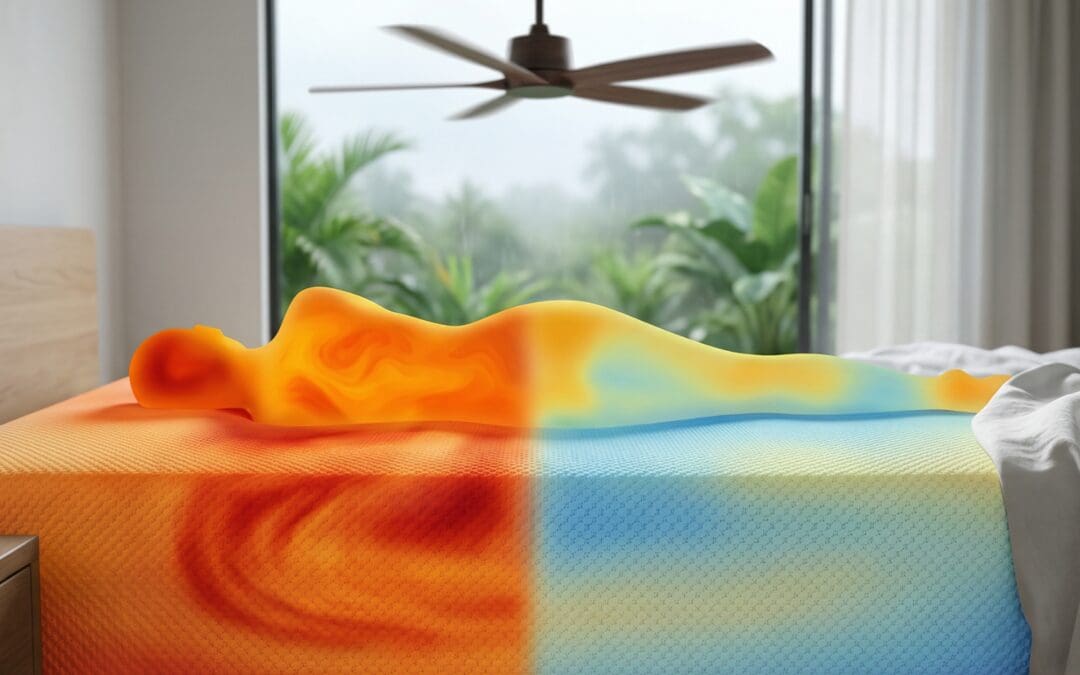
Why does this matter? High humidity reduces your body’s ability to cool itself through sweat evaporation. Your skin stays damp. Your sheets absorb moisture. And your mattress, if it traps heat and does not allow airflow, becomes a heat reservoir that radiates warmth back into your body all night.
This is why so many Darwin residents describe waking up feeling like they “never cooled down.” The room might drop a few degrees overnight. But if the mattress holds heat and the humidity stays high, your body never gets the signal to enter deep, restorative sleep.
What This Means for Your Mattress Choice
The data confirmed something we have been telling customers for years: the mattress is the single biggest variable you can control in a hot bedroom.
You cannot control Darwin’s climate. Air conditioning helps, but it has limits (and running it on full all night pushes power bills past $500 a month in the wet season). Ceiling fans help with perceived airflow, but they do not change the surface temperature where your body makes contact.
A mattress built with open-cell airflow technology, breathable cover fabrics, and materials that do not trap body heat can reduce the surface temperature where you sleep by several degrees compared to a standard foam or pillow-top mattress. That difference matters when your bedroom is already sitting at 28 degrees.
Dense memory foam and thick pillow-top layers are the worst performers in this environment. They absorb body heat, hold it, and release it slowly. In a cool Melbourne bedroom, that might feel cosy. In Darwin, it makes sleep miserable.
Cooling mattresses built for tropical airflow use materials that actively move heat away from the sleep surface. Pocket spring systems with open coil structures allow air to circulate through the mattress core. Breathable knit covers let moisture escape rather than pooling on the surface.
The Air Conditioning Trap
One of the most interesting findings was how little difference air conditioning made once the mattress was working against the sleeper.
In three of the air-conditioned homes, the residents were still reporting poor sleep despite bedroom temperatures below 26 degrees. When we checked their mattresses, all three were older foam or pillow-top models with no airflow design. The air conditioning cooled the room, but the mattress surface stayed warm because the materials trapped body heat on contact.
This is a pattern we see regularly in our mattress fitting consultations. People assume the room temperature is the whole problem. They spend thousands upgrading their air conditioning before realising the mattress is the issue.
A well-designed mattress in a room with just a ceiling fan can outperform a heat-trapping mattress in a fully air-conditioned room. That was one of the clearest takeaways from the data.
Practical Steps Based on the Data
If you are sleeping hot in Darwin, here is what the numbers suggest you focus on, in order of impact:
Your mattress comes first. Replace any mattress that uses dense foam, thick pillow tops, or materials with no airflow channels. Look for pocket spring cores with open coil structures, breathable covers, and foams designed to dissipate rather than store heat. The premium mattress range at Top End Mattress is specifically built around airflow technology for this reason.
Your sheets matter more than you think. Ditch polyester blends. Use 100 percent cotton or bamboo-blend sheets with a low thread count (between 300 and 400). Higher thread counts trap more heat.
Your pillow is part of the problem. Memory foam pillows hold heat the same way memory foam mattresses do. Switch to a ventilated latex or a hollow-fibre pillow if you sleep hot.
Air conditioning helps, but set it right. The sleep research suggests setting your split system between 22 and 24 degrees if you run it overnight. Lower than that and you risk waking from cold air on your skin while your mattress surface stays warm, which confuses your body’s temperature regulation.
Fan placement changes everything. A ceiling fan pulls warm air up. A pedestal fan pointed at the bed pushes cooler floor-level air across the sleep surface. Using both together is more effective than either alone.
Why This Data Matters for Darwin Buyers
Most mattress advice online is written for southern Australian climates. Reviews tested in Sydney or Melbourne do not account for sustained overnight temperatures above 27 degrees and humidity above 70 percent for six months of the year.
Darwin is a different sleep environment. The mattress that works in Hobart will not work in Humpty Doo. The data from these 10 homes confirms that choosing a mattress based on national reviews, without considering tropical performance, leads to poor sleep and wasted money.
If you want to see how different mattress materials actually feel in person and talk through which option suits Darwin’s climate and your body, book a free sleep consultation at our Jape Homemaker Village showroom. We will walk you through the options based on how you sleep, not a sales script.