
Every mattress brand in Australia now claims to sell a “cooling mattress.” Open any mattress website and you will find phrases like “advanced cooling technology,” “temperature-regulating sleep surface,” and “cool gel infusion for a refreshing night.” It sounds impressive. Most of it means very little.
If you live in Darwin and you have bought a mattress marketed as “cooling” only to wake up sweating at 2am, you are not imagining things. The problem is not your bedroom. The problem is that the mattress industry has turned “cooling” into a marketing label with no standard definition, no testing requirements, and no accountability.
This post breaks down which cooling claims are real, which are exaggerated, and what actually keeps you cool when your bedroom sits above 27 degrees for half the year.
The Problem With “Cooling Gel”
Cooling gel is the most common claim in mattress marketing. It comes in two forms: gel-infused foam and gel memory foam. Both sound technical. Neither works the way most buyers expect.
Gel-infused foam contains small gel beads mixed into the foam during manufacturing. The idea is that gel absorbs heat faster than foam alone, pulling warmth away from your body. And it does, most noticeably when you first lie down. But gel can only keep drawing heat away if that heat has somewhere to go. Buried in a solid block of foam, it warms up to your body temperature and the mattress starts to behave like regular foam.
This is fine in a climate where nighttime temperatures drop into the teens. In Darwin’s wet season, where bedroom temperatures stay above 27 degrees all night, a gel layer sitting on solid foam is not enough on its own. What sits underneath the gel matters more than the gel itself.
Gel memory foam follows the same rule. The gel speeds up how quickly heat leaves your skin, but a mattress made only of dense memory foam has very little airflow, so once the gel warms up the heat stays put. Put that same gel memory foam layer on top of a pocket spring core, the way hybrid mattresses are built, and the springs keep air moving underneath it all night.
If you have ever read a mattress review that says “feels cool at first but heats up during the night,” this is why.
“Breathable Cover” Does Not Mean Breathable Mattress
Another common claim is the “breathable knit cover” or “moisture-wicking fabric.” These are real features. A well-made cover fabric can move sweat away from your skin and allow some airflow at the surface level. That part is not nonsense.
The problem is when a breathable cover sits on top of a dense foam core that traps heat. The cover wicks moisture from the surface, but the heat building inside the mattress has nowhere to go. It is like putting a mesh shirt on top of a plastic bag. The outer layer breathes, but the system does not.
A truly cooling mattress needs airflow through the entire structure, not just at the cover. The core construction matters far more than the fabric on top.
What Actually Works for Tropical Heat
Three mattress construction methods perform well in sustained heat. Each works differently, and some work better than others in Darwin’s specific climate (high humidity, high overnight temperatures, six or more months of the year).
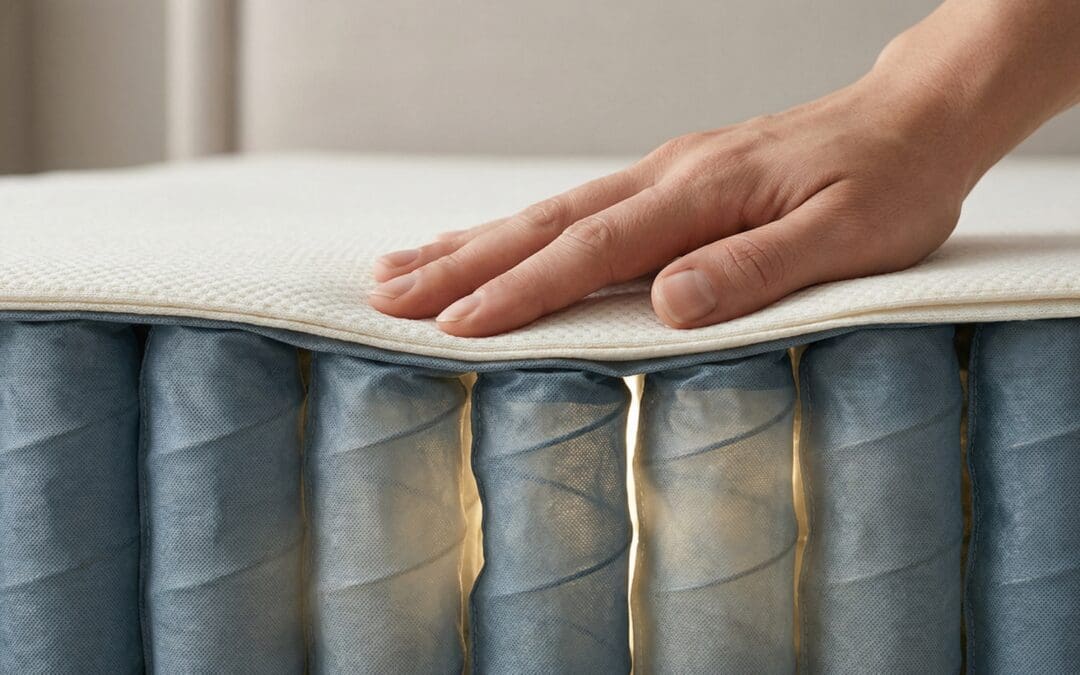
Open-coil pocket spring systems. Pocket springs are individually wrapped coils that compress independently. The space between the coils creates natural air channels throughout the mattress core. When you move during sleep, the springs compress and decompress, pushing air through those channels. This passive ventilation system works all night because it is powered by your own body movement, not a material that “fills up” with heat.
This is the construction method that performs best in Darwin based on what we see in our showroom and the feedback from customers across the northern suburbs. A pocket spring core with a breathable comfort layer on top consistently outperforms foam-based mattresses in tropical bedrooms.
Natural latex (Dunlop or Talalay process). Latex has an open-cell structure, which means air can pass through the material rather than getting trapped inside it. Talalay latex in particular has a more open cell structure than Dunlop and performs slightly better for heat dissipation. Latex also does not contour as aggressively as memory foam, which means less body contact and less heat transfer from skin to mattress.
The downside of latex in Darwin is that it performs better in dry heat than humid heat. High humidity reduces the effectiveness of any material that relies on evaporative cooling. Latex is still a strong option, but it works best when paired with a pocket spring core rather than used as the full mattress construction.
Hybrid builds with ventilated comfort layers. A hybrid mattress combines a pocket spring core with a thin foam or latex comfort layer on top. The key word is “thin.” A 2cm to 3cm comfort layer provides pressure relief at the shoulders and hips without creating the deep heat sink that a 10cm foam layer does. The spring core underneath handles the heavy lifting on airflow.
This is the construction profile behind the premium mattress range at Top End Mattress. Pocket spring cores with targeted comfort zones, breathable covers, and comfort layers that work with the springs rather than smothering them.
What Does Not Work in Darwin
Thick memory foam mattresses. Traditional memory foam is dense and holds warmth. It conforms closely to your body shape, which feels supportive but also maximises skin contact and heat transfer. In a cool climate, this is fine. In Darwin, it creates a heat cocoon that gets worse as the night goes on.
Pillow-top mattresses with deep padding. Pillow tops add a thick layer of padding on the sleep surface. This padding compresses under body weight, creating a bowl shape that wraps around you. More contact surface equals more heat transfer. The padding also restricts air movement at the exact point where it matters most: between your body and the mattress core.
Mattress-in-a-box foam models. Most mattress-in-a-box brands sell compressed foam mattresses shipped in a rolled package. The convenience is real. The cooling performance in tropical climates is not. These mattresses are almost always made from dense polyurethane foam or memory foam with no spring core and no meaningful airflow channels.
If you are in Darwin and you buy one of these based on a review written by someone in Melbourne, you will likely be disappointed. The climate difference is that significant.
How to Test a Cooling Claim Before You Buy
There are a few questions that cut through the marketing:
Ask about the core construction. If the mattress is foam all the way through, it will hold more heat. If it has a pocket spring core, it has built-in airflow. This single question filters out most poor performers.
Ask about comfort layer thickness. A comfort layer thicker than 4cm on top of springs starts to reduce airflow benefits. Thinner comfort layers with higher density perform better than thick, soft layers.
Ask whether the “cooling” feature is a material property or a structural design. Gel infusion is a material property, and it works best when there is airflow underneath it. Open-coil airflow is a structural design that works continuously. The distinction matters.
Try it in person. Lie on the mattress for at least 10 minutes. If you start feeling warmth building under your lower back and shoulders within that time, the mattress is not going to perform well over an eight-hour Darwin night. This is why we offer [free mattress fittings at our showroom /book-an-appointment/] where you can spend real time on each mattress rather than guessing from a website photo.
The Honest Position
We sell mattresses. We have a clear bias toward wanting you to buy one from us. But we also live and work in Darwin, and we sleep on these mattresses in the same climate you do.
The honest position is this: no mattress will make a 30-degree bedroom feel like a 20-degree bedroom. What a well-designed mattress does is stop making the problem worse. A mattress that allows airflow, minimises heat retention, and keeps the sleep surface a few degrees cooler than the surrounding air gives your body a fighting chance at quality rest.
That is not a miracle. It is engineering. And it is the difference between waking up rested and waking up stuck to your sheets.
If you want to compare how different constructions actually feel in Darwin’s climate, visit us at Jape Homemaker Village. We will walk you through the full mattress range and show you exactly what is inside each mattress so you can make your own call.
Book a free consultation or just walk in during business hours. No pressure, no scripts, no marketing buzzwords.