
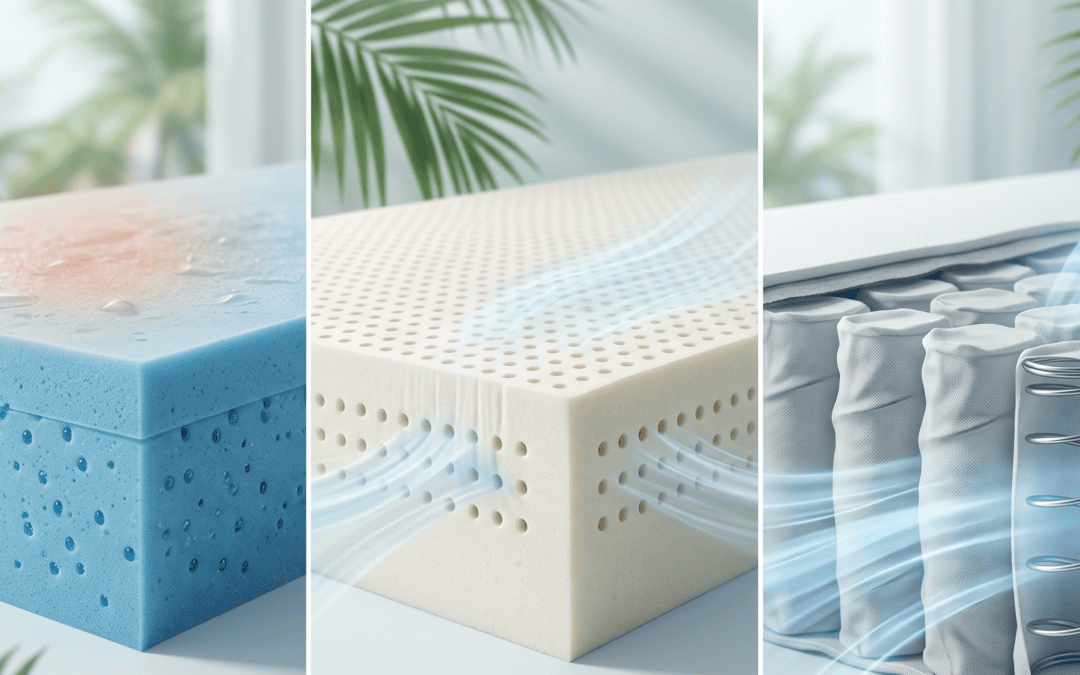
Three mattress technologies dominate the “cooling” conversation in Australia: gel foam, latex, and pocket springs. Each one handles heat differently. Each one has real strengths and real limitations. And the way they perform in Darwin’s sustained humidity is not the same as how they perform in a climate-controlled testing lab in Sydney.
This is a side-by-side breakdown of how each technology manages heat, where each one falls short, and which construction works best when your bedroom sits above 27 degrees and 75 percent humidity for six months of the year.
How Heat Builds in a Mattress
Before comparing materials, it helps to understand why mattresses get hot in the first place.
Your body generates heat constantly, even while you sleep. At rest, the average adult produces roughly 70 to 80 watts of thermal energy. That heat transfers into whatever surface your body is touching. In bed, that surface is the mattress.
If the mattress material absorbs that heat and holds it, the sleep surface temperature rises. Your body responds by sweating, which is meant to cool you down through evaporation. But if the mattress material also traps moisture (or if the ambient humidity is too high for efficient evaporation), the surface stays hot and damp. This is the cycle that makes tropical sleep miserable.
The three variables that determine how well a mattress handles this cycle are: thermal conductivity (how quickly the material moves heat away from the surface), airflow (whether air can pass through the material to carry heat away), and moisture management (whether the surface allows sweat to evaporate or traps it).
Gel Foam: Cool to the Touch, Needs Airflow Underneath
Gel foam comes in two forms. Gel-infused foam mixes small gel beads or particles into standard polyurethane foam. Gel memory foam adds gel to viscoelastic (memory) foam. Both are marketed as cooling technologies.
How it handles heat. Gel has higher thermal conductivity than foam alone. It absorbs heat from your body faster than plain foam, which creates an initial cooling sensation when you first lie down. This is real, and it is most noticeable when you first lie down: a gel foam mattress does feel cooler than a non-gel foam mattress.
The catch is where that heat goes next. Gel beads are small. They absorb heat quickly, but they can only keep doing it if the heat can move on. In an all-foam mattress it has nowhere to go, so over a long, hot night the gel warms up and the foam behaves like standard foam: it holds heat.
How it handles airflow. Poorly. Both polyurethane foam and memory foam are closed-cell or semi-closed-cell materials. Air cannot move through them. There are no channels, no gaps, no ventilation paths. Heat that enters the foam stays in the foam until it slowly dissipates through conduction, which is a much slower process than convective airflow.
How it handles humidity. Badly. Closed-cell foam does not breathe. In a high-humidity environment, moisture from sweat collects on the surface and has nowhere to go. The cover fabric may wick some moisture away from the skin, but the moisture then sits trapped between the cover and the foam layer. In Darwin’s wet season, that trapped moisture is what leaves an all-foam mattress feeling clammy and damp.
Bottom line for Darwin. In an all-foam mattress, gel is not enough on its own for 8 hours of high humidity. It works best as a comfort layer over a pocket spring core (a hybrid), where the springs keep air moving underneath while the gel keeps the surface feeling cool.
Latex: Better Breathing, Humidity Dependent
Latex mattresses use either natural rubber latex (harvested from rubber trees) or synthetic latex (petroleum-based). Natural latex is available in two production methods: Dunlop (denser, heavier) and Talalay (lighter, more consistent cell structure).
How it handles heat. Latex has an open-cell structure, which means the material contains interconnected air pockets rather than sealed bubbles. This allows air to move through the material to some degree, carrying heat away from the sleep surface more effectively than closed-cell foam.
Talalay latex has a more uniform and open cell structure than Dunlop, which gives it slightly better airflow and heat dissipation. Both types perform significantly better than gel foam for sustained heat management.
How it handles airflow. Moderately well. The open-cell structure creates passive airflow paths through the material. Some latex mattresses also include pin-hole patterns (small holes punched through the latex layer) to increase air circulation. This helps, but it is not the same as the active airflow you get from a spring core where air moves freely through large open channels.
How it handles humidity. This is where latex performance varies by climate. In dry heat (Alice Springs, inland Queensland), latex performs well because the open cells allow moisture to evaporate efficiently. In high humidity (Darwin, Cairns, coastal tropics), the effectiveness drops. When the ambient air is already saturated with moisture, evaporative cooling through the latex becomes less efficient. Moisture still escapes faster than from closed-cell foam, but slower than in dry conditions.
Natural latex also has inherent antimicrobial properties that resist mould and dust mite growth, which is a genuine advantage in humid climates where moisture-related hygiene issues are more common.
Bottom line for Darwin. Latex is a meaningful improvement over gel foam for heat management. It breathes better, moves heat more effectively, and resists moisture-related degradation. But as a standalone mattress material (an all-latex mattress), it works better in dry heat than in Darwin’s sustained humidity. Where latex performs best in the tropics is as a comfort layer on top of a pocket spring core, combining the pressure relief of latex with the superior airflow of springs.
Pocket Springs: Structural Airflow That Works All Night
Pocket spring mattresses use hundreds of individually wrapped steel coils as the support core. Each coil sits in its own fabric pocket and compresses independently of the surrounding coils.
How they handle heat. Pocket springs do not absorb or store heat the way foam and latex do. Steel coils have minimal thermal mass compared to foam. The heat management benefit of pocket springs is not about the material properties of the metal. It is about the structure.
The spaces between individually pocketed coils create a network of air channels throughout the mattress core. This is a fundamentally different approach to cooling. Instead of relying on the material itself to conduct or absorb heat, the spring structure allows air to physically move through the mattress.
How they handle airflow. This is where pocket springs outperform every foam and latex option. When you move during sleep (shifting position, rolling over, adjusting your weight), the springs compress and decompress. This bellows-like action pushes warm air out of the mattress and draws cooler air in through the sides and base.
This is passive ventilation powered by your own body movement. It does not rely on a material property that degrades or saturates. It works continuously throughout the night, every night, for the life of the mattress. In a Darwin bedroom at 28 degrees and 78 percent humidity, this structural airflow is the single most effective cooling mechanism available in any mattress construction.
How they handle humidity. Well. The open air channels allow moisture to escape the mattress interior rather than pooling inside foam layers. This reduces moisture accumulation, slows material degradation, and creates a drier sleep surface. In Darwin’s wet season, a pocket spring mattress core stays significantly drier internally than an all-foam or all-latex alternative.
The comfort layer factor. Pocket spring mattresses are not just springs. They have a comfort layer on top (foam, latex, or fibre padding) that provides pressure relief at the shoulders and hips. The thickness and material of this comfort layer affects how well the spring system’s airflow reaches the sleep surface.
A thinner comfort layer lets more of the spring airflow reach the surface, while a very thick pillow-top insulates the surface from the springs and reduces the cooling benefit. This is why premium mattresses built for tropical conditions pair their comfort foam with breathable covers and zoned pocket springs.
Bottom line for Darwin. Pocket springs provide the most effective and sustained cooling of any mattress construction available. The structural airflow works all night, is not affected by humidity saturation, and does not degrade over time. For Darwin’s climate, a pocket spring core is the foundation of any mattress that claims to sleep cool.
The Hybrid Approach: Why Combining Materials Works Best
The best-performing mattresses in tropical climates combine a pocket spring core with a thin latex or breathable foam comfort layer on top. This hybrid approach gives you:
The structural airflow of pocket springs for sustained heat dissipation. The pressure relief of latex or responsive foam for comfort at the shoulders and hips. Minimal insulation at the surface, so the spring airflow actually reaches your skin.
This is the construction profile behind the mattresses in our cooling mattress range. Pocket spring cores with targeted comfort zones, breathable covers, and no thick foam layers that create a heat barrier between you and the ventilated core.
A Direct Comparison
| Feature | All-Foam Gel | Latex (Talalay) | Pocket Springs |
|---|---|---|---|
| Initial cooling | Good | Moderate | Neutral |
| Sustained cooling (8 hrs) | Poor | Moderate | Strong |
| Airflow through material | None | Moderate | Excellent |
| Performance in high humidity | Poor | Moderate | Strong |
| Moisture management | Poor | Good | Good |
| Durability in tropical heat | Lower | Good | Strong |
| Motion isolation | Good | Good | Excellent |
| Pressure relief | Good | Good | Depends on comfort layer |
What This Means for Your Purchase
If you are buying a mattress in Darwin and cooling is a priority (and for most Darwin buyers, it should be), the material hierarchy is clear: pocket springs outperform latex, and both outperform all-foam gel mattresses for sustained tropical heat management. If you love the feel of gel memory foam, choose it as a layer on top of pocket springs rather than in a solid foam mattress.
That does not mean you need the most expensive option on the floor. The affordable mattress range includes pocket spring models that deliver genuine airflow at entry-level prices. The premium range adds higher coil counts, zoned support, and refined comfort layers for sleepers who want maximum performance.
The best way to feel the difference between these technologies is in person. Lie on an all-foam mattress for 10 minutes, then lie on a pocket spring for 10 minutes. You will feel the temperature difference under your lower back and shoulders. That 10-minute test tells you more than any product page.
Book a free mattress fitting at our Jape Homemaker Village showroom and we will walk you through the construction of each option so you can compare with your own body, not a spec sheet. Afterpay and Payright are available across all ranges.