
The mattress industry loves the “8-year rule.” You have probably seen it repeated on every mattress website, sleep blog, and retail brochure in Australia. Replace your mattress every 8 years. Simple, clean, convenient.
It is also misleading. The real lifespan of a mattress depends on what it is made of, how much weight it supports, what climate it lives in, and how well it was built. Some mattresses fail after 3 years. Others perform well past 12. Telling every buyer to replace at 8 years serves the industry’s sales cycle more than it serves the consumer.
Here is what actually determines how long your mattress lasts, and how to tell when yours is done.
Where the 8-Year Rule Comes From
The “replace every 8 years” guideline traces back to mattress industry marketing in the US during the early 2000s. The Better Sleep Council, a trade organisation funded by mattress manufacturers, promoted this figure through consumer campaigns. It was not based on a specific clinical study or material science finding. It was a marketing consensus designed to encourage more frequent purchases.
That does not mean 8 years is wrong for every mattress. It means it is an average applied to all mattresses equally, regardless of quality, construction, or use conditions. And averages hide the details that actually matter.
A poorly made foam mattress in a hot climate supporting two heavy adults might fail in 3 to 4 years. A well-built pocket spring mattress in the same conditions might last 10 to 15 years with proper care. Lumping both under the same replacement timeline helps one and misleads the other.
What Actually Determines Mattress Lifespan
Construction Quality
The single biggest factor is what the mattress is made of and how well those materials are assembled.
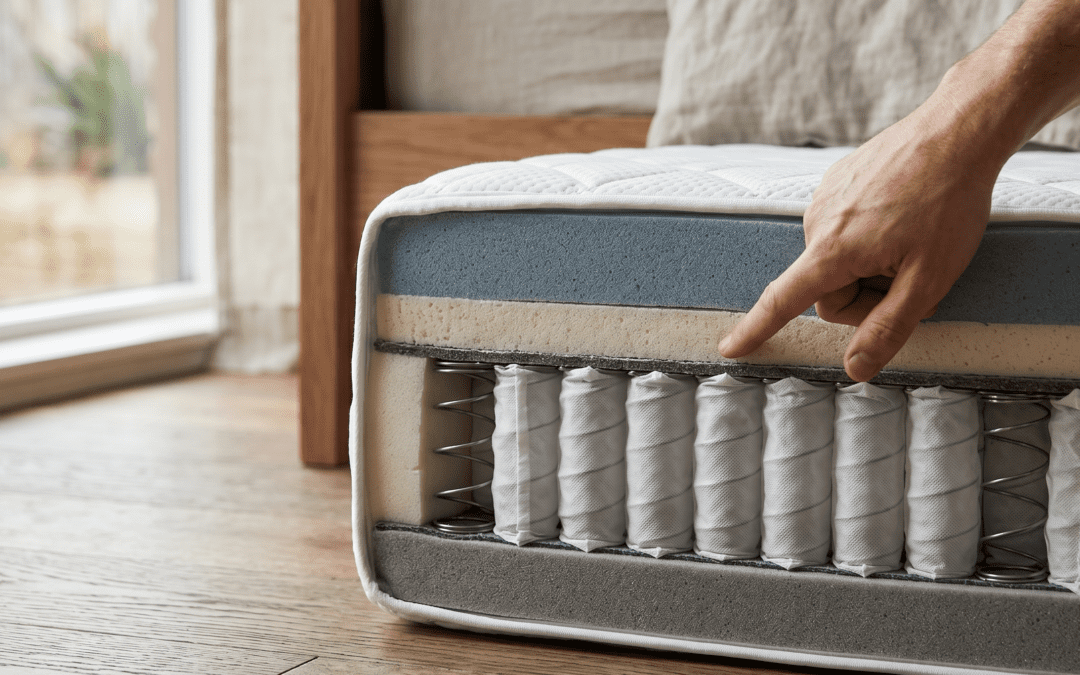
Spring gauge and coil count. In pocket spring mattresses, thicker wire gauge (lower numbers, like 1.6mm to 1.8mm) means stronger springs that resist deformation longer. Higher coil counts distribute weight across more support points, reducing the load on each individual spring. A mattress with 1,000+ pocket springs will maintain its support profile significantly longer than one with 600.
Foam density. Not all foam is equal. Density is measured in kilograms per cubic metre. Cheap mattresses use low-density foam (under 30kg per cubic metre) that compresses permanently within a few years. Quality comfort layers use foam at 40kg per cubic metre or above. The difference in longevity is dramatic, often double or triple the useful life.
Edge support construction. The edges of a mattress experience disproportionate stress, especially if you sit on the edge of the bed regularly. Reinforced edge support (using firmer foam encasements or dedicated edge springs) prevents the perimeter from collapsing and extends the usable surface area over time.
Comfort layer thickness and design. Thicker pillow-top layers feel plush initially but compress faster because there is more material under load. Thinner, denser comfort layers with zoned firmness tend to hold their shape longer.
Body Weight and Usage
A mattress supporting two adults at a combined weight of 180kg will degrade faster than the same mattress supporting a single 70kg sleeper. This is basic material science: more weight means more compression, more compression means faster material fatigue.
If you and your partner are on the heavier side, investing in a mattress built for higher load capacity (thicker spring gauge, higher coil count, denser foams) will pay off in longevity. The [premium mattress range /product-category/premium-range/] is built with these specifications for exactly this reason.
Climate and Environment
This is where Darwin buyers need to pay extra attention. Heat and humidity accelerate the breakdown of mattress materials in ways that southern Australian buyers rarely experience.
Foam degradation. Heat softens foam. A memory foam mattress in a room that regularly exceeds 27 degrees overnight will soften and lose its support properties faster than the same mattress in a 20-degree Melbourne bedroom. The foam does not just feel softer temporarily while warm. Repeated heating and cooling cycles break down the cellular structure of the foam over time, creating permanent body impressions.
Moisture damage. High humidity means more moisture in the mattress, both from sweat and from ambient air. Moisture trapped inside foam layers promotes microbial growth and accelerates material deterioration. In Darwin’s wet season, a mattress without adequate airflow is absorbing significantly more moisture than the manufacturer designed for.
Spring oxidation. In extreme humidity environments, the metal springs inside a mattress can develop surface oxidation over time. This is less of an issue with modern coated springs, but older or cheaper mattresses with uncoated wire will weaken faster in tropical conditions.
This is one reason [mattresses with open-coil pocket spring cores /services/cooling-mattress/] perform better in Darwin. The airflow channels through the spring system allow moisture to escape rather than sit trapped in the mattress core. Better ventilation means slower material degradation.
Signs Your Mattress Is Done
Forget the calendar. Your mattress tells you when it is finished. Here is what to look for.
Visible body impressions. If you can see a dip where you normally sleep when the bed is empty, the support materials have permanently compressed. A depression deeper than 2 to 3 centimetres means the mattress can no longer hold your spine in a neutral position.
You wake up sore but feel better after moving around. This is the classic sign of a mattress that has lost support. Your body compensates for the sagging surface by tensing muscles overnight. Once you get up and move, the tension releases and the stiffness fades. If this pattern happens daily, the mattress is the likely cause.
The mattress feels noticeably different from when you bought it. Memory is imperfect, but most people can tell when a mattress has gone from supportive to saggy. If you sleep at a hotel or a friend’s house and notice a dramatic difference in comfort, your mattress at home has probably degraded more than you realised.
You are sleeping hotter than before. As foam layers compress, they become denser. Denser foam traps more heat. If your mattress feels warmer than it used to, the materials have likely broken down and are no longer allowing the same level of airflow.
Your partner rolls toward the centre. Uneven compression creates a slope toward the middle of the mattress. If you and your partner keep ending up in the same spot, the support zone between you has collapsed.
The Cost-Per-Night Calculation
Price alone does not tell you whether a mattress is good value. Lifespan does. Here is a simple way to compare.
A $500 mattress that lasts 3 years costs you 46 cents per night. A $2,000 mattress that lasts 10 years costs you 55 cents per night. The per-night cost is remarkably similar, but the $2,000 mattress gives you 7 extra years of proper support, better sleep quality, and no interim replacement hassle.
Now factor in the hidden costs of a failing mattress: physiotherapy visits for back pain, lost productivity from poor sleep, replacement bedding to compensate for a hot surface, and the environmental cost of sending a mattress to landfill every 3 years. The higher upfront investment almost always wins on total cost.
The [affordable mattress range /product-category/affordable-range/] at Top End Mattress starts well under $1,000, and even these entry-level pocket spring options are built with materials designed for Darwin’s climate. They will outlast cheap foam alternatives by years. [Afterpay and Payright /services/afterpay-mattress/] are available if the upfront cost is a barrier.
How to Make Your Mattress Last Longer
Rotate it every 3 to 4 months. Spin the mattress 180 degrees (head to foot) to distribute wear evenly across the surface. Most modern mattresses are not designed to be flipped (they have a specific top and bottom), but rotation helps significantly.
Use a breathable mattress protector. A good protector prevents sweat, spills, and dust mites from penetrating the mattress surface. In Darwin, choose a protector with a breathable membrane rather than solid vinyl. You want protection without blocking airflow.
Ventilate the bedroom. Let air move through the room during the day when possible. Open windows in the dry season. Use fans to keep air circulating. Reducing ambient humidity around the mattress slows material degradation.
Do not sit on the edges regularly. Edge-sitting puts concentrated load on the smallest part of the mattress. If you use the edge of your bed as a seat (putting on shoes, for example), try to vary the spot you use.
Strip the bed occasionally. Once a month, remove all bedding and let the mattress air out for a few hours. This lets trapped moisture evaporate, especially important during the wet season.
The Bottom Line
Your mattress does not have an expiry date stamped on the tag. The 8-year rule is a convenient fiction that helps mattress companies sell more product. Some mattresses last far longer. Some fail far sooner. The difference comes down to materials, construction, body weight, and climate.
In Darwin, the climate factor is real and significant. Heat and humidity accelerate foam degradation, moisture buildup, and material fatigue. A mattress built for tropical conditions with proper airflow and durable materials will outperform and outlast a cheaper alternative, often by years.
If you are not sure whether your current mattress is still doing its job, [book a free sleep consultation /book-an-appointment/] and come in to test what a properly supportive mattress feels like. Sometimes the easiest way to tell your old mattress is done is to lie on one that is not.
The [full mattress range /product-category/mattress/] is available to try in our Jape Homemaker Village showroom. No appointment needed to browse, but a fitting gives you a personalised recommendation based on your body and your budget.