
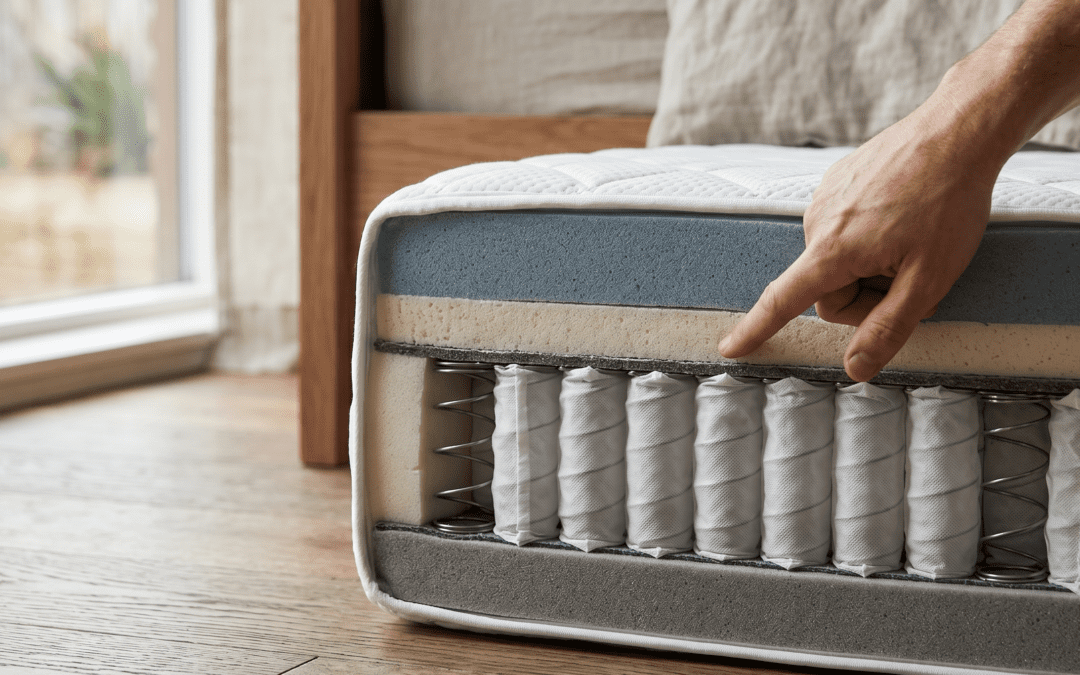
Mattress-in-a-box brands have changed how Australians buy mattresses. Order online, get it delivered in a compressed roll, unbox it in the bedroom, and sleep on it tonight. No showroom visit, no salesperson, no weekend lost to shopping. It is convenient, and convenience sells.
But there is a growing gap between the promise and the reality. Return rates on online mattresses are high. Customer satisfaction data tells a more complicated story than the five-star reviews on brand websites suggest. And the environmental cost of the “try it for 100 nights” model is something the industry does not talk about at all.
This is not an anti-online shopping argument. It is a look at the costs that do not appear on the product page.
The Return Rate Problem
Online mattress brands built their business model around risk-free trials. “Sleep on it for 100 nights. If you don’t love it, return it for free.” It sounds generous. It is also a signal that a significant percentage of buyers will not love it.
The mattress industry does not publish standardised return rate data, but estimates from industry analysts and logistics companies suggest that online mattress return rates sit between 10 and 20 percent across major brands. Some brands report lower figures, but these often exclude exchanges (where a customer swaps for a different firmness rather than returning outright) and customers who keep a mattress they are unhappy with because the return process feels like too much effort.
Compare that to in-store mattress purchases, where return rates are typically under 5 percent. The difference is straightforward: people who test a mattress with their own body before buying are far more likely to get the right one.
A 10 to 20 percent return rate means that for every 10 mattresses shipped, 1 to 2 come back. Each return involves a pickup, transport, and the question of what happens to the mattress afterward.
Where Returned Mattresses Actually Go
This is the part the industry prefers not to discuss in detail.
A mattress that has been slept on for 30, 60, or 90 nights cannot be resold as new. Health regulations and consumer expectations both prevent this. So what happens to them?
Some returned mattresses are donated to charities or shelters. This is the outcome brands highlight in their sustainability messaging. But charities have limited capacity to accept mattresses, and many shelters have hygiene policies that restrict accepting used bedding.
Some are recycled. Mattress recycling involves separating the steel springs, foam, and fabric components for individual processing. This is possible but expensive, and recycling infrastructure for mattresses in Australia is limited. Most recycling facilities are in major cities. In regional areas, including the Northern Territory, mattress recycling options are minimal.
The reality is that a significant portion of returned mattresses end up in landfill. A standard queen mattress takes up roughly 0.7 cubic metres of landfill space and takes decades to decompose. The steel springs do not break down. The foam degrades slowly and releases chemicals into the soil. The fabric and adhesives add to the problem.
When a brand ships 100,000 mattresses a year and 15,000 come back, that is a substantial volume of waste generated by a business model that treats mattresses as a try-before-you-commit proposition rather than a considered purchase.
The Firmness Guessing Game
The core problem with buying a mattress online is that you are guessing. You are reading a product description, looking at a firmness rating (usually a number from 1 to 10), and hoping it matches what your body needs.
Firmness is subjective. A mattress rated “7 out of 10” by the manufacturer feels different under a 60kg side sleeper than it does under a 95kg back sleeper. The same mattress can feel medium to one person and firm to another. Online reviews help, but every reviewer has a different body, a different sleeping position, and a different bedroom temperature.
In Darwin, there is an additional variable that online brands do not account for. Foam-based mattresses soften in heat. A mattress that feels medium-firm when you unbox it in a 22-degree air-conditioned room will feel noticeably softer once your bedroom hits 28 degrees during the wet season. The firmness you tested during the dry season is not the firmness you sleep on in January.
This is not something you can assess from a product page. It is something you learn by testing the mattress in a showroom environment where staff can explain how materials perform in tropical conditions.
The “Free Trial” Is Not Actually Free
The 100-night trial removes upfront financial risk. You can return the mattress if you do not like it. But the trial period has costs that are not measured in dollars.
Time cost. You sleep on an unsuitable mattress for weeks or months while deciding whether it is “good enough.” During that time, poor sleep quality affects your energy, mood, cognitive function, and physical recovery. For FIFO workers, parents, and anyone with a demanding schedule, weeks of subpar sleep have a real impact.
Decision fatigue. The trial period creates an ongoing evaluation cycle. Instead of buying a mattress and sleeping on it, you spend weeks assessing whether it is right, reading forums, comparing your experience to reviews, and going back and forth on whether to return it. This cognitive load is a cost, even if it does not show up on a receipt.
Return logistics. “Free returns” means the brand covers the pickup cost. But you still need to be home for the pickup window, strip the bed, potentially move the mattress to an accessible location, and arrange a replacement while you wait for either a refund or a new mattress to arrive. In Darwin, where delivery and pickup logistics are slower than in Sydney or Melbourne, this process can stretch over weeks.
The sunk cost trap. After sleeping on a mattress for 60 or 70 nights, many people convince themselves it is “fine” even when it is not. The effort of returning, waiting for a refund, and starting the search again feels worse than keeping a mediocre mattress. The trial period is supposed to protect buyers, but in practice it often leads to settling.
What You Miss By Not Testing in Person
A 10-minute test on a showroom mattress tells you things that no product page can communicate.
How the mattress supports your specific body shape. Your weight distribution, shoulder width, hip width, and spinal curvature are unique. A mattress that supports one body type perfectly may create pressure points or alignment issues for another. You can only assess this by lying on the mattress in your natural sleeping position.
How the surface temperature feels. In a showroom, you can feel within minutes whether a mattress surface retains heat or allows airflow. Online, you find out after the mattress has been in your 28-degree bedroom for a few nights.
How the mattress responds to movement. Rolling over, changing position, and getting in and out of bed all feel different on different mattresses. Motion transfer, edge support, and responsiveness are physical experiences that text descriptions cannot replicate.
How the mattress compares to alternatives. In a showroom, you can lie on three or four mattresses back to back and feel the differences directly. Online, you are comparing product descriptions and firmness ratings, which is like comparing restaurants by reading their menus without tasting the food.
A mattress fitting at our Jape Homemaker Village showroom takes about 20 to 30 minutes. In that time, we assess your body type, sleeping position, and any pain issues, then walk you through the options that match. You test each one and make a decision based on how it actually feels under your body, not how a reviewer in Melbourne described it.
The Convenience Trade-Off
Online mattress buying is convenient. That is its primary value proposition, and it is a real one. Not everyone has a showroom nearby. Not everyone wants to spend a Saturday shopping. And for people in remote areas with no local mattress store, online may be the only option.
But in Darwin, convenience is not the barrier. Top End Mattress is at Jape Homemaker Village in Millner, which is central to the northern suburbs and an easy drive from Palmerston, Howard Springs, and Humpty Doo. You can walk in during business hours without an appointment, or book a consultation to get a dedicated fitting session.
The convenience of online buying comes with a real cost: a higher chance of getting the wrong mattress, weeks of poor sleep during the trial period, and the environmental waste generated by the return model. For most Darwin buyers, a 30-minute showroom visit eliminates all of those risks.
Making an Informed Decision
If you are considering an online mattress, ask these questions before ordering:
What is the return rate for this product? If the brand will not share it, that tells you something.
What happens to returned mattresses? If the answer is vague (“we partner with charities”), push for specifics.
How does the firmness perform in temperatures above 25 degrees? If the brand has not tested in tropical conditions (and most have not), the firmness rating may not be accurate for your bedroom.
Can you visit a showroom to test it? Some online brands have physical showrooms in Sydney and Melbourne. If there is no way to test the product, you are accepting a level of risk that a local showroom visit eliminates.
The full mattress range is available to test in person at our Jape Homemaker Village showroom. Every mattress is on the floor for you to lie on, compare, and decide with your body rather than a product description. Afterpay and Payright are available, and local delivery is handled by our team, not a third-party courier.